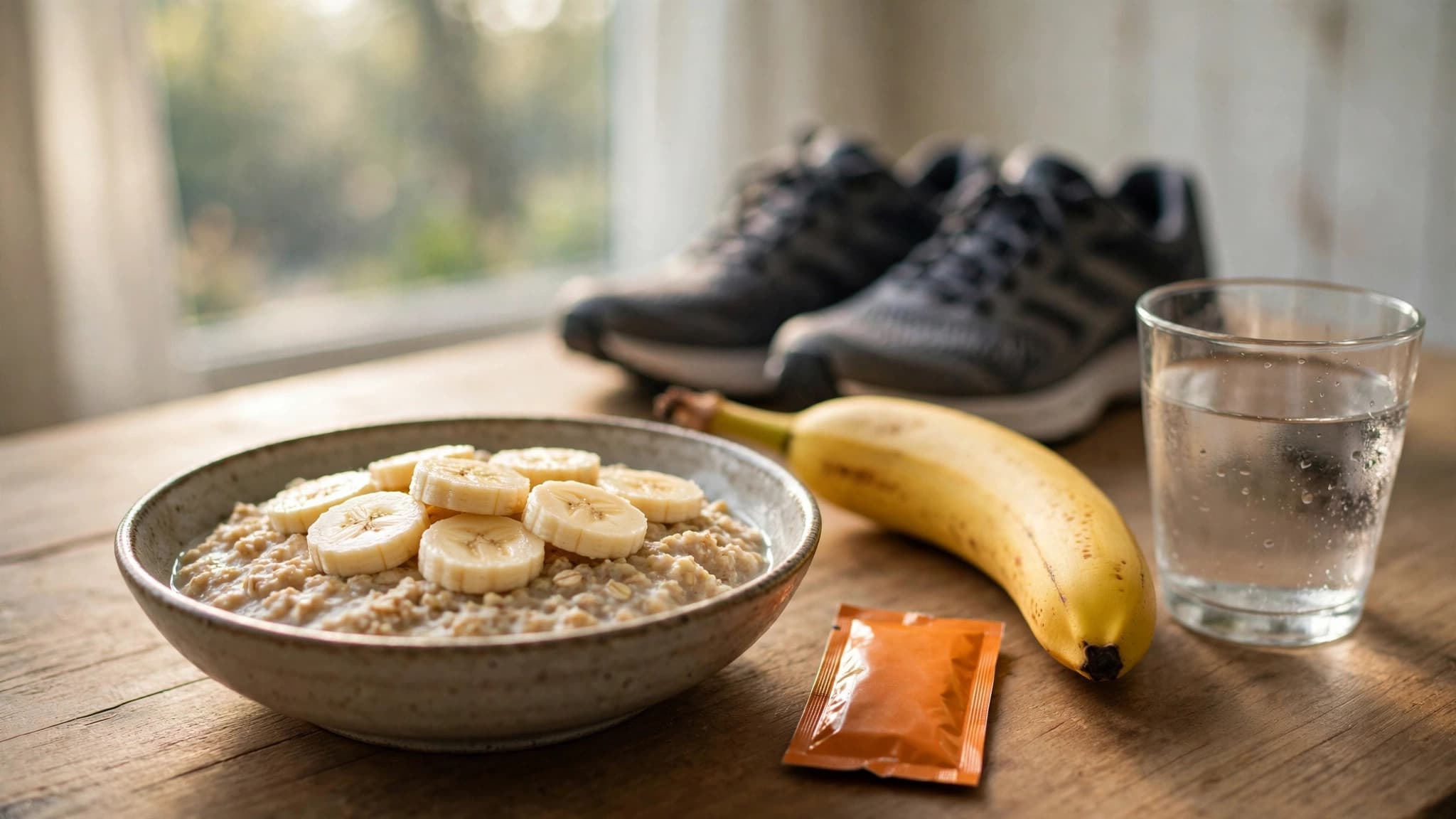
Fueling Guide
Running Nutrition
Eat enough of the right things at the right times, and your recovery will tell you. A plain-English guide to fueling before, during, and after your runs.
The short answer
Before: eat a familiar carb-based meal 2–3 hours out, or a small snack like a banana 60–90 minutes before. During: for runs longer than about 75–90 minutes, take 30–60g of carbs per hour — roughly a gel every 30–45 minutes with water. After: carbs plus protein within a couple of hours; a real meal beats a perfect window. Under-fuel, and it shows up tomorrow: flat energy, heavy legs, worse recovery.
- Before: carbs 2–3h out, small snack 60–90 min before
- During: 30–60g carbs/hr past ~75–90 min
- After: carbs + protein; total daily intake beats timing
- Before
- Carbs 2–3h out; banana 60–90 min
- During
- 30–60g carbs/hr past ~75 min
- After
- Carbs + protein, real meal
- Recovery link
- Under-fuel → flat recovery
Running nutrition has a reputation for being complicated. It isn't. Your body needs fuel before hard efforts, fuel during long ones, and rebuilding material after — and it tells you clearly when you're getting it wrong. The runners who struggle with nutrition usually aren't eating the wrong superfood; they're simply not eating enough, or they're trying something new on the day it matters most.
There's also a feedback loop most guides skip: today's fueling shows up in tomorrow's recovery. Under-eat around a big session and you'll feel it the next morning — flat energy, heavy legs, and recovery metrics that sag. Eat well and the same training feels almost suspiciously manageable. Fueling is part of training, not an accessory to it.
Before the run: timing matters more than the food
The closer to the run, the smaller and simpler the meal. The further out, the more normal it can be.
| When | Eat | Examples |
|---|---|---|
| 3–4 hours before | A normal, carb-based meal | Oatmeal with banana, rice with chicken, pasta. |
| 2 hours before | A moderate meal, lower in fat and fiber | Toast with jam, a bagel, rice cakes. |
| 60–90 minutes before | A small, familiar snack | A banana, a handful of pretzels, applesauce. |
| Under 30 minutes | Only if you need it — keep it tiny | Half a banana or a few chews. Nothing new. |
Two things to avoid: high fiber and high fat close to the run (both slow digestion and cause mid-run stomach trouble), and anything you haven't eaten before a run previously. Your pre-race breakfast should be the most boring meal you eat all year — the same thing you've practiced a dozen times.
During the run: fuel the long ones
For runs under about 75–90 minutes, you don't need to eat mid-run — your stored glycogen covers it. Past that point, your body starts running low, and that's where fueling changes the run. The standard target is 30–60 grams of carbs per hour: a gel every 30–45 minutes with water, or chews, or sports drink. Start at the low end and work up; guts adapt to processing carbs on the move, but only with practice.
The practice part is non-negotiable. Every gel brand sits differently, and race day is the worst possible time to discover yours doesn't. Use your long runs as fueling rehearsals: same product, same timing, same water strategy you'll use in the race. In heat, add electrolytes — salt loss is the other half of the bonk equation.
After the run: rebuild with real food
After hard or long efforts, eat a meal with carbs and 20–40g of protein within a couple of hours. It doesn't need to be immediate and it doesn't need to be a shake — rice and chicken, a big sandwich, eggs on toast all do the job. The carbs refill glycogen; the protein gives your muscles the material to repair.
After easy runs, just eat your next normal meal. The recovery industry wants you to believe every jog needs a protocol; it doesn't. Save the deliberate refueling for the sessions that actually depleted you, and make sure you're eating enough across the whole day — chronic under-eating is the quiet performance killer in distance running.
Race week: eat more, try nothing
In the two to three days before a marathon or half marathon, eat slightly more carbohydrate than usual — bigger portions of familiar foods, not a pasta-binge the night before. Your glycogen stores top up gradually. The night-before dinner should be something you've eaten before a long run many times.
Race morning, eat your practiced breakfast at your practiced time, then stop thinking about food until the fueling plan kicks in. The runners with the calmest stomachs on the start line are the ones who changed nothing.
How fueling shows up in your recovery
Here's the part that closes the loop. A big session fueled well leaves you tired but bouncy the next day; the same session under-fueled leaves you flattened — heavy legs, low motivation, and recovery signals (HRV, resting heart rate, sleep quality) that all sag together. Coaches read that pattern instantly: it's the signature of an energy deficit, not a fitness problem.
If your recovery data keeps dipping after hard days despite reasonable training, look at your plate before your plan. The fix is usually eating more, not training less — and it's the cheapest performance upgrade in running.
Frequently asked questions
What should I eat before a morning run?
For an easy run under an hour, you can go out fasted if that feels fine — many runners do. For anything harder or longer, eat something small and carby 60–90 minutes before: a banana, toast with jam, or oatmeal. The key rule is familiarity: race morning is never the time to test a new breakfast.
How many gels should I take during a marathon?
Aim for roughly 30–60 grams of carbs per hour, which works out to about one standard gel every 30–45 minutes, taken with water. Practice the exact brand and timing on long runs first — your stomach needs training too. Most marathon blowups blamed on fitness are actually fueling failures.
Do I need protein right after every run?
After easy runs, your next normal meal covers it. After long or hard efforts, get 20–40g of protein plus carbs within a couple of hours — a real meal beats a perfectly timed shake. The '30-minute window' is less strict than supplement marketing suggests; total daily intake matters more.
Should runners eat low carb?
For most runners, no. Carbohydrate is the primary fuel for running at any meaningful intensity, and chronically under-eating carbs is one of the fastest routes to heavy legs, stalled progress, and suppressed recovery. Some experienced athletes experiment with periodized approaches, but 'just eat fewer carbs' is bad default advice for a runner.
What should I drink on long runs?
Water for most runs up to 90 minutes. Beyond that, or in heat, add electrolytes — either a sports drink or water plus salty food/gels. Drink to thirst as a baseline; the goal is to finish the run not much lighter than you started, not to force a schedule.
Why do I feel nauseous when I eat on runs?
Usually one of three things: too much at once, too little water with it, or a product your gut hasn't practiced with. Fix it by taking smaller amounts more often, always with water, and rehearsing on training runs — never debut a gel on race day. If nausea is persistent even with small amounts, scale the effort back; hard running diverts blood from the gut.
Related
HRV and Recovery
How under-fueling shows up in your recovery data the next morning.
Marathon Training Plan
Long runs are where fueling strategy gets built — practice it there.
How to Taper for a Race
Race-week eating: slightly more carbs, nothing new.
Race Time Predictor
Set a goal time, then fuel the training that earns it.
Get the app free
Free tier · no credit card